
Cadre
Turn AI into digital employees you can manage.
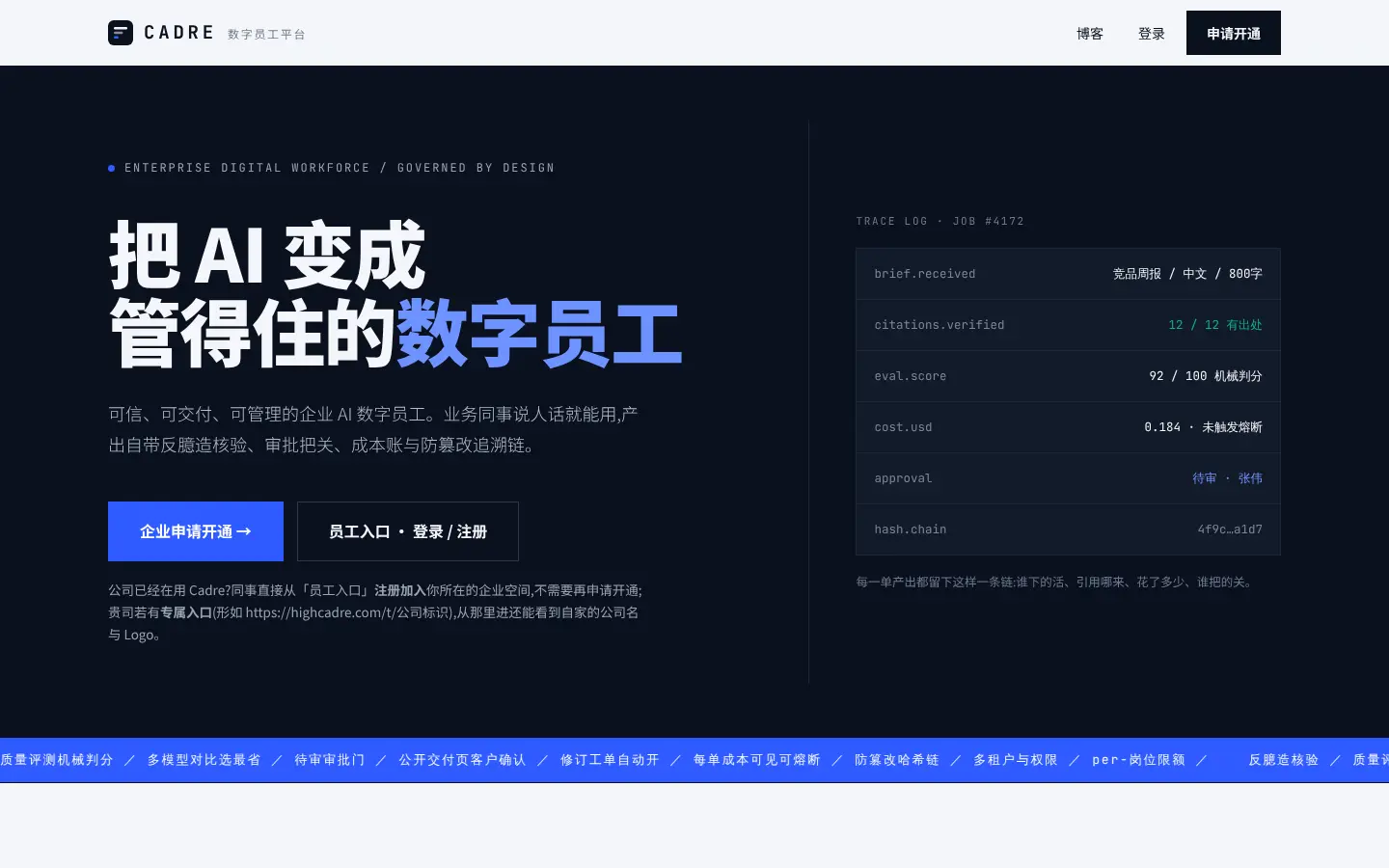
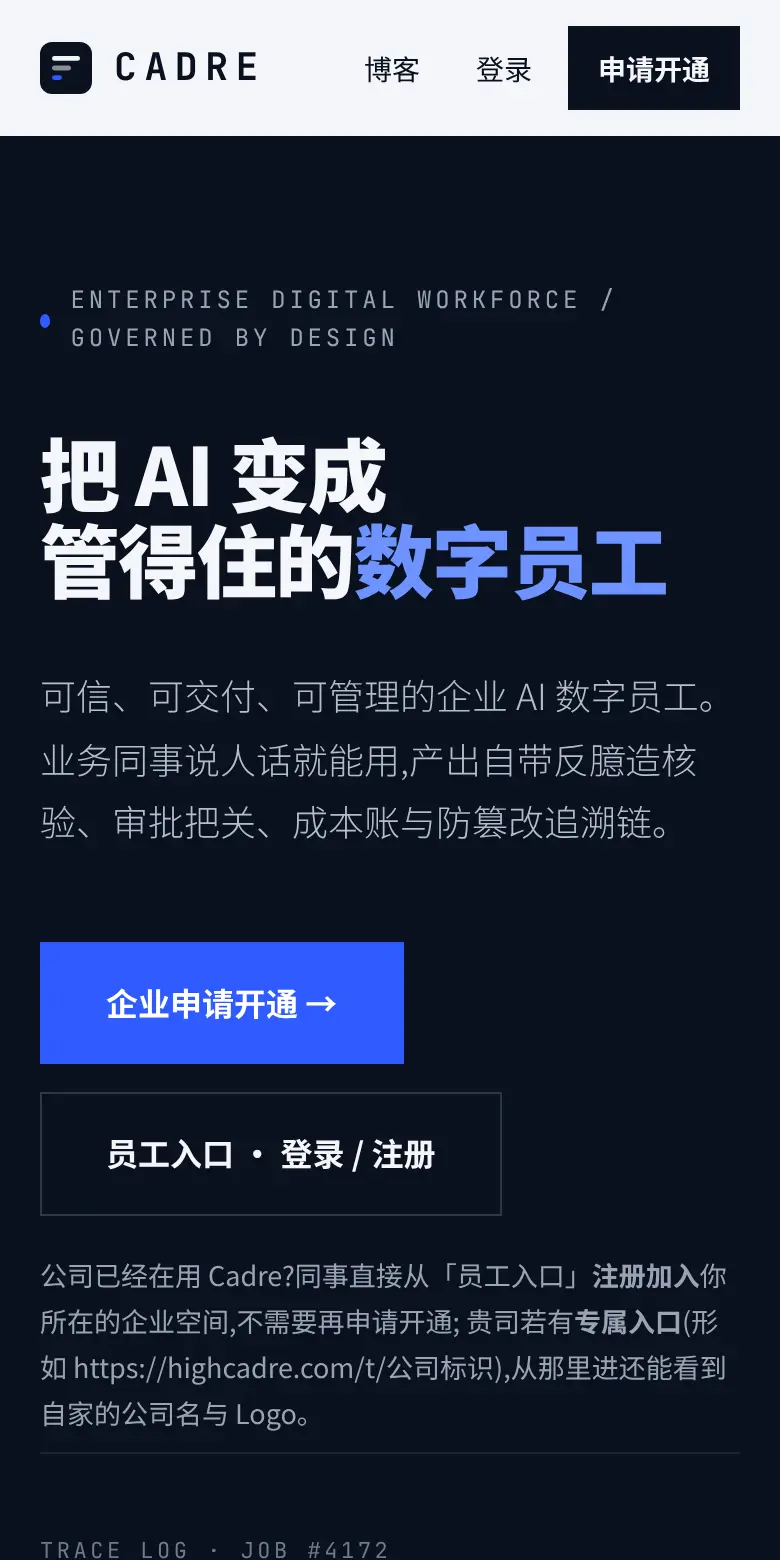
Cadre is an enterprise digital-employee platform that organises AI into role-based digital employees, such as product managers, researchers and content operators, whose work comes with source checks, human approval, per-job cost limits and a tamper-evident audit trail.
Cadre at a glance
- What it is
- A platform that runs AI as role-based digital employees, with governance built in
- Roles
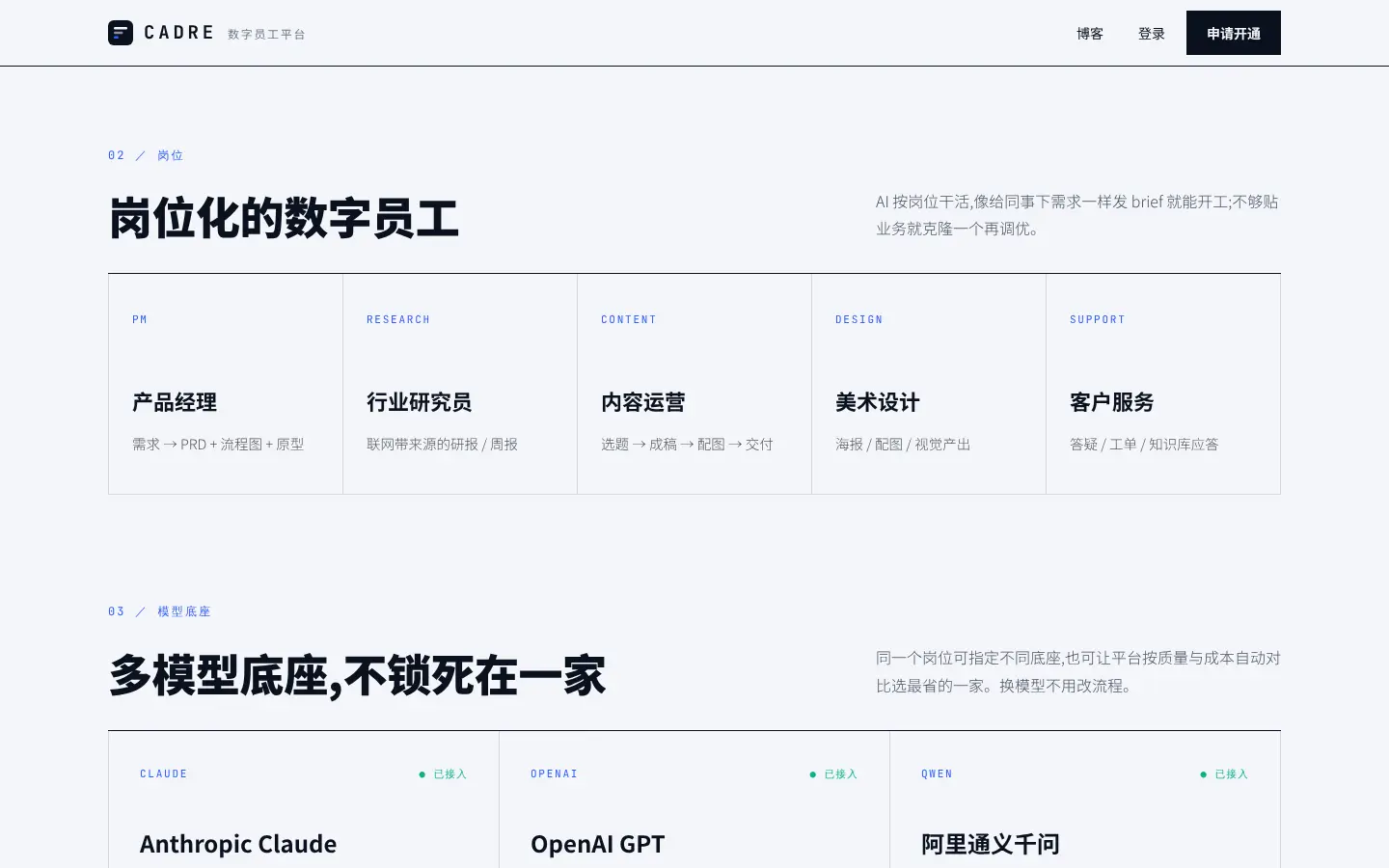
- Product manager, industry researcher, content operations, design and customer support; any role can be cloned and tuned
- Models
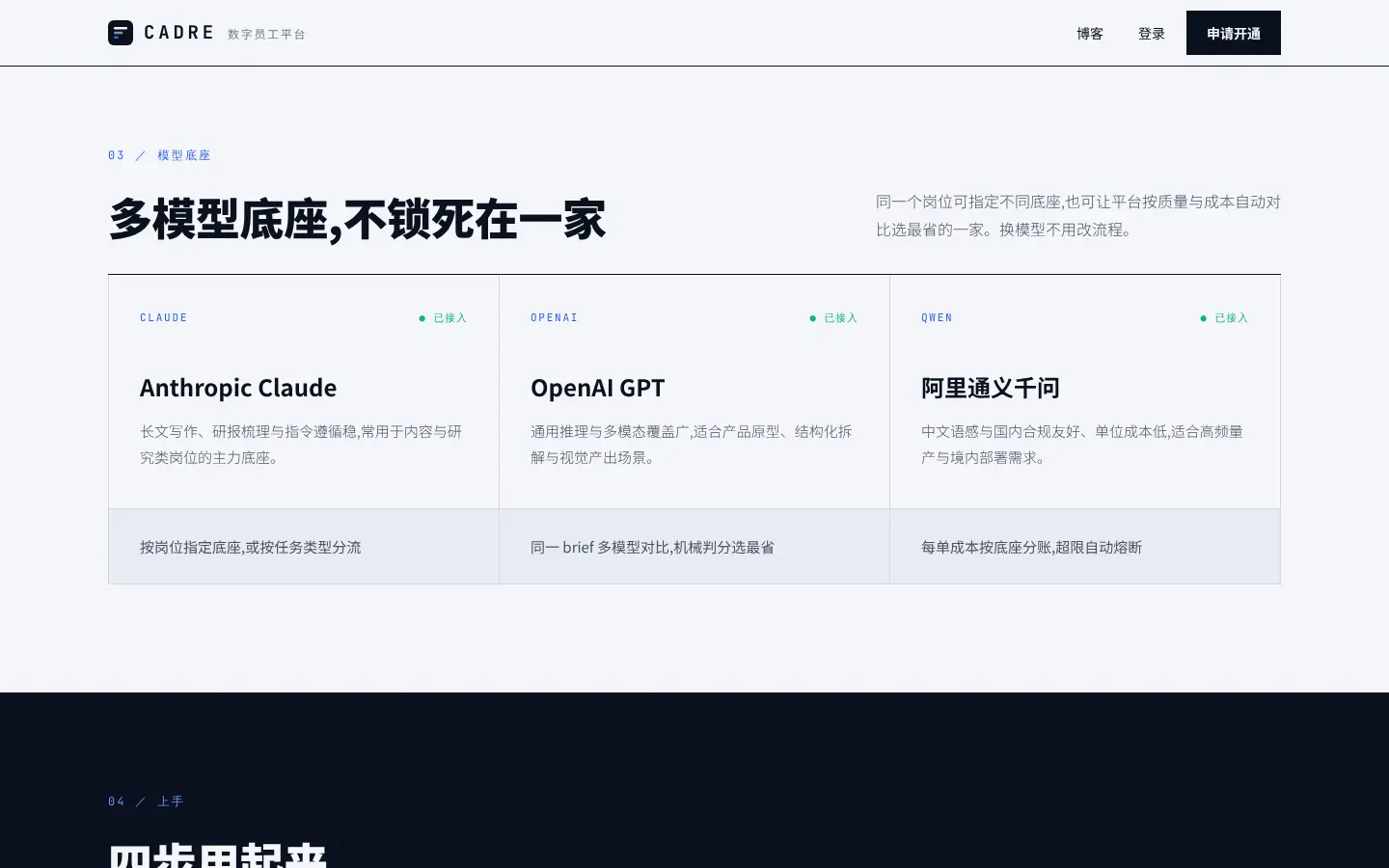
- Anthropic Claude, OpenAI GPT and Alibaba Qwen, set per role or compared per job to pick the cheapest that passes
- Governance
- Citation checks, machine-scored evaluation, an approval gate, per-job cost limits, a tamper-evident hash chain, multi-tenant permissions and per-role quotas
- Access
- Web app for teams that apply, plus an OpenAI-compatible API; the interface is in Chinese
- Price
- Free trial once your company’s application is approved
- Made by
- NGMOB Pte. Ltd., Singapore
What Cadre is
Cadre treats AI as a team rather than a chat box. Each digital employee has a role: a product manager turns a request into a PRD, a flow chart and a prototype; an industry researcher writes sourced reports and weekly briefings from the web; a content operator goes from topic to draft, images and delivery; a designer makes posters and visuals; and a support agent answers questions from a knowledge base. You brief them the way you would brief a colleague, in plain language.
What sets Cadre apart is governance. Every job leaves a record of who asked for it, where its citations came from, how it scored, what it cost and who approved it, chained so it cannot be quietly edited. Citations must point to real sources, output is scored automatically, a brief can run on several models to pick the cheapest that passes, and per-job costs are visible with an automatic cut-off. Nothing reaches a client until it clears an approval gate and a delivery page where the client confirms or asks for changes, which opens a revision ticket.
Cadre runs on Anthropic Claude, OpenAI GPT and Alibaba Qwen, so switching models does not change the workflow. It suits small and mid-sized content, marketing, product and research teams today; private deployment for regulated enterprises is in progress. Companies apply for access, colleagues join through the employee sign-in or their company’s own link, and developers can call Cadre through an OpenAI-compatible API.
- ready-made roles
- 5ready-made roles
- model families: Claude, GPT and Qwen
- 3model families: Claude, GPT and Qwen
- steps from brief to reusable skill
- 4steps from brief to reusable skill
- workflow changes to switch models
- 0workflow changes to switch models
What you can do with Cadre
- Role-based digital employees
- Product manager, researcher, content operator, designer and support, each with a workflow you can clone and tune.
- Citation checks
- Claims must link to a real source before work is handed over.
- Machine-scored quality
- Every output is scored automatically, and one brief can run on several models to pick the cheapest that passes.
- Approval and client delivery
- An approval gate and a delivery page for client sign-off; feedback opens a revision ticket.
- Cost control
- Token and dollar costs per job, split by model, with an automatic cut-off when a limit is hit.
- Audit trail and tenancy
- A tamper-evident hash chain, multi-tenant permissions and per-role quotas.
Cadre screens
Questions about Cadre
What is Cadre?
Cadre is an enterprise platform that runs AI as role-based digital employees: product managers, industry researchers, content operators, designers and support agents. Their work comes with citation checks, machine scoring, human approval, visible per-job costs and a tamper-evident audit trail.
Who makes Cadre?
Cadre is built by NGMOB Pte. Ltd., a software studio in Singapore. Its website is highcadre.com.
How is Cadre different from using ChatGPT or an AI agent?
General tools connect steps and leave people to check every sentence. Cadre manages the AI: output proves itself with citation checks and scoring before hand-over, every job’s cost is visible and capped, approvals and a hash-chain trail record who signed off, and business staff brief it in plain language.
Which AI models does Cadre use?
Anthropic Claude, OpenAI GPT and Alibaba Qwen. Each role can use a set model, or the platform can run the same brief on several models, score the results and choose the cheapest one that passes.
How do I get access?
Companies apply at highcadre.com/apply for a free trial. If your company already uses Cadre, join through the employee sign-in or your company’s own link. Developers can call it through an OpenAI-compatible /v1/chat/completions API with a Cadre key, billed to the company’s quota.
Who is Cadre for?
Today it fits small and mid-sized content, marketing, product and research teams, such as brand and cross-border e-commerce content teams, SaaS growth teams and research studios. Private deployment for regulated large enterprises is in progress.
Facts last checked on 2026-10-30 against highcadre.com. Built with Anthropic Claude, OpenAI GPT, Alibaba Qwen, OpenAI-compatible API, Hash-chain audit log.
Writing about Cadre
- Cadre: Digital Employees You Can AuditCadre runs AI as role-based digital employees, and every job is source-checked, scored, approved and costed before it reaches a client. Here is how.
- Eleven Rules for Letting AI Agents Commit Codeagents-md is our open-source rulebook for AI coding agents: how Claude Code, Cursor and Codex should branch, commit, run CI and touch databases safely.
- Twenty-Two Products, One Stack: The NGMOB LineupEighteen live products and four labs, from Tapestra and Cadre to Duomi, GlowFrame, CarbClue and LaunchKit: what each one does and where agents fit in.